
FAQ
Before participating in the study, each ambulance organisation received training and practice in delivering advanced life support with double sequential defibrillation. Here, we have compiled some of the questions that arose during training, so you can easily find the answers and share them. If you would like to know more, please contact us: info@doubled-trial.org
Q: If there is a public defibrillator or emergency services with a defibrillator on site, can we combine these and perform double sequential defibrillation?
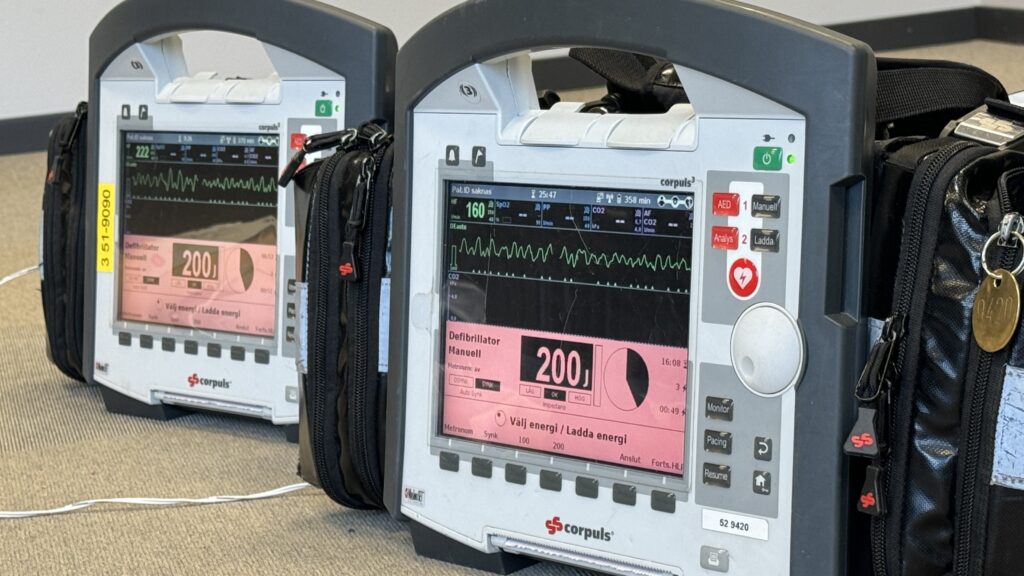
A: No, only the combination of Corpuls3 + Corpuls3 in manual mode is permitted for double sequential defibrillation. This is because the safety of other combinations has not been evaluated by the manufacturers.
Q: Does it matter which defibrillator is used first in double sequential defibrillation?
A: Aim to start with the defibrillator connected in the standard antero-lateral position.
Q: What grip should be used when pressing the button during double sequential defibrillation (one finger or thumb grip)?
A: The most important point is avoid delivering both shocks simultaneously, but to ensure the time gap is as short as possible (less than one second). The simplest method is for one person to operate both defibrillators, using one hand for each.
Q: If the patient has received double sequential defibrillation and achieves ROSC, but ventricular fibrillation reoccurs, should DSD be performed again?
A: Yes. Keep all four pads in place until the patient is stabilised for transport. If ventricular fibrillation reoccurs, perform double sequential defibrillation.
Q: For how long should we perform double sequential defibrillation during resuscitation?
A: Continue the double sequential defibrillation strategy until the patient achieves ROSC, CPR is discontinued, or a decision is made to transport the patient while CPR is ongoing. If transport is required, aim to perform three double sequential defibrillations on-site before transporting with ongoing CPR to hospital, in line with standard procedures and considerations. If it is safe and feasible to transport two defibrillators in the ambulance, double sequential defibrillation can be performed during transport. Otherwise, standard defibrillation with a single defibrillator should be used during transport to hospital.
Q: How should the adhesive defib pads be positioned if the patient has a pacemaker/ICD?
A: The presence of a pacemaker or ICD does not prevent defibrillation or participation in the study. Place the defib pads as usual, but ensure that no adhesive pad is positioned directly over the pacemaker. The nearest pad should be at least 8 cm from the pacemaker.
Q: What must be done after a cardiac arrest case where a randomisation envelope was used?
A: After completing the mission, regardless of inclusion group or randomisation outcome, that is, whether the patient was randomised to double sequential defibrillation or standard treatment:
1. Scan the QR code on the randomisation card and enter the details; both unit numbers (Swe: Rakelnummer) must be registered.
2. Complete the cardiac arrest information (CPR registry) in your EMS charting system as accurately as possible.
After completing the mission, if double sequential defibrillation was performed:
3. Perform a functionality test on the defibrillator by turning it off and on – this will initiate an automatic self-test.
4. Test the defibrillation function by performing a test defibrillation with a test box. This should be done as soon as possible, and no later than at shift change.
Q: What should we do if we arrive at a cardiac arrest together with an ambulance from another area, which is not part of the study, as the second vehicle?
A: If it is your patient and you are the first unit on site, the patient can be included. However, if the situation is reversed – that is, you are supporting another ambulance outside your area that is not part of the study – the patient cannot be included at this time.
Q: How and when has information been communicated to emergency departments and nearby ambulance areas? What does it consist of?
A: All receiving hospitals were provided with information before the study began, in the form of an informational letter. Please note that DoubleD is a prehospital study; once the patient has been handed over to the hospital, the intervention is complete, and the hospital continues treatment according to standard procedures and guidelines.

Q: How long does it actually take to apply two pairs of defibrillator pads, for example, on a large person with a hairy chest and back?
A: Studies indicate that it takes approximately 12 to 15 seconds longer than applying a single pair of pads. If the application is coordinated during a breathing pause, the back (posterior) pad can be applied in less than ten seconds in our scenario exercises. However, the actual time required in real-life situations is one of the research questions we hope to answer with this trial.
Q: How should the second pair of defibrillator pads be applied during ongoing LUCAS-CPR?
A: One suggestion is to turn off the LUCAS device, but do not remove it. Tilt the patient 30-45 degrees, keeping the suction cup on the patient, and attach the posterior pad. Return the patient to the supine position and check that the suction cup is correctly positioned. Restart the LUCAS device and attach the second anterior pad.
Q: How many randomisation envelopes are placed per ambulance and where are they located?
A: Each ambulance will have one randomisation envelope placed with the adhesive pads for the defibrillator. If the envelope has been used, notify your nearest supervisor or local study coordinator, and a new envelope will be provided as soon as possible.
Q: What about Corpuls1, can it be used in this trial?
A: Currently, only the Corpuls3 is available, and it is the only device to be used in the study.
Q: What about other defibrillators, such as AED:s in gyms?
A: First, always switch from the AED to Corpuls3 using your defibrillator pads. If the patient has been defibrillated with an AED, they can still be included, but double sequential defibrillation can currently only be performed with two Corpuls3 defibrillators in manual mode.
info@doubledtrial.org
If you have any further questions, please do not hesitate to get in touch.
Q: What about informed consent for study participation – when does it occur, does anything need to be said on site?
A: Informed consent is obtained from individuals once they regain the capacity to process information. We have ethical approval to conduct the study in this way. There is already a weak recommendation from ILCOR regarding double sequential defibrillation, and it does not need to be explained or confirmed on site.